

This article is part of MalevaHealth.com’s campaign to raise awareness about the importance of prostate cancer screening. While we don’t include sponsored links here, some linked content may contain marketing material. We believe this topic is too important to be cluttered with product links. When it comes to cancer, always consult a doctor or medical professional.
If you’re a man over 50 — or younger with certain risk factors — your prostate may not be top of mind. But here’s a reality check: prostate cancer is one of the most common cancers in men. According to the American Cancer Society (ACS), in the United States in 2025, the number of new cases of prostate cancer is projected to be more than 313,000. In the UK, the charity Prostate Cancer UK reports there are around 55,000 new prostate cancer diagnoses each year.
What this means for you: ignoring mere symptoms or delaying the talk with your doctor may cost you time and options. Screening and open discussion are your allies. The importance of prostate screening can’t be overstated, but it’s not for everyone.
Let’s dig into why this matters, the numbers, what to look for, and how the conversation with your doctor might go.

Why the numbers matter
- In the U.S., prostate cancer is projected to account for roughly 15% of all new cancer cases among men in 2025. Seer.Cancer.Gov
- In Canada, the Canadian Cancer Society estimates around 27,900 men will be diagnosed with prostate cancer in 2024, and about 5,000 will die from it. Canadian Cancer Society
- In Australia, according to the Australian Institute of Health and Welfare via Cancer Australia, prostate cancer is expected to be the most commonly diagnosed cancer in men in 2024, with about one in six men (≈ 18 %) being diagnosed by age 85. canceraustralia.gov.au
- Across many countries, survival is much better when prostate cancer is caught early. For example, in Canada, the 5‑year net survival rate is about 91% for prostate cancer. Canadian Cancer Society
These stats tell us this is not a rare issue — and broadly speaking, catching it early considerably improves your odds.
How screening helps
Screening means checking for signs of disease before you might feel symptoms. For prostate cancer, this often involves a blood test called the PSA (prostate‑specific antigen) test, possibly a digital rectal exam (DRE), and follow‑up if things look unusual.
The benefits:
- Detecting cancer when it is contained in the prostate (before it spreads).
- Giving you more treatment options, some of which have fewer side effects.
- Reducing the risk of the cancer advancing to a stage where treatment is more complex and side effects are more severe.
The trade‑offs:
- Some prostate cancers grow very slowly and might never cause serious harm.
- Screening sometimes leads to over‑detection (finding cancers that might never have caused problems), which can lead to unnecessary treatment and its side‑effects (urinary incontinence, erectile dysfunction).
That’s why the best approach isn’t “automatically screen everyone at all ages,” but “know your risk, talk it through with your doctor, weigh pros and cons, decide together.”

What to watch for: early signs of prostate cancer
Prostate cancer in its early stages may not cause symptoms. That’s why screening is so helpful. But when symptoms appear, here are common ones men should ask themselves about:
- A need to urinate more often, especially at night — also called nocturia — can be an early sign. Learn more about frequent urination here.
- Difficulty starting or stopping urination (weak stream).
- Blood in urine or semen.
- Pain or burning during urination or ejaculation.
- Pain in the back, hips, or pelvis that doesn’t go away.
- New onset of erectile dysfunction.
If you experience these — especially if you’re in a higher‑risk group (age 50+, family history of prostate cancer, certain ethnicities) — it’s time to see your doctor without delay.

Who is at higher risk?
- Age: The risk increases significantly after age 50, and is higher after 65. SEER
- Family history: Having a father or brother diagnosed with prostate cancer raises your risk.
- Ethnicity: In some countries, Black men have a higher risk of developing and dying from prostate cancer. zerocancer.org
- Others: Genetic mutations (e.g., BRCA1/2), lifestyle factors may contribute.
If you tick any of those boxes, file that under “Important: Talk to my doctor about prostate health.”
Why the talk matters
You might think: “I’ll wait until I have symptoms.” That might be too late. Talking with your doctor about your prostate health allows you to:
- Get a baseline: “What is my PSA now?” If you have a baseline, future changes stand out.
- Understand your personal risk: Your doctor can advise based on age, family history, ethnicity, general health, and life expectancy.
- Weigh screening options: Do you screen now? How often? What if PSA is raised? What are the next steps?
- Set up plan: “If PSA rises, we’ll do X” before it becomes urgent.
- Reduce anxiety: You know you’ve taken a step rather than avoiding it.
Let Me Give You an Example (Anonymized for Privacy Reasons)
Let me tell you a story — imagine John, age 62, healthy, works full time, plays golf, no significant complaints. He keeps telling himself he’s “too busy” to see the doctor for a prostate check. One day, he notices he’s waking at night more often to pee, but thinks it’s just aging. Six months later, his doctor suggests a PSA test and finds the level is elevated. He follows up with a biopsy, and it shows early, localized prostate cancer. Because it was caught early, the tumor is contained, treatment is less invasive, and his prognosis is excellent. He can still play golf, still be active with his grandchildren, and his treatment side effects are minimal.
Now imagine a version of that story where John waited until he felt pain or bone symptoms. By then, the cancer had advanced to the pelvic bones. Treatment is more complex, recovery harder, side effects more likely.
Which version do you want for yourself? You want plan A (early detection, better outcomes,) not plan B (late detection, fewer options).
Here’s what you want:
- To avoid being surprised by a diagnosis.
- To maintain quality of life (sexual function, urinary control, active living).
- To have choices in treatment rather than face limited options.
- To have peace of mind knowing you did something, not ignored something.
Screening + a doctor‑discussion = a “you in control of the story” scenario.

FAQ questions & answers about the importance of prostate screening
What exactly is the PSA test, and what does it tell me?
The PSA (prostate‑specific antigen) test is a blood test that measures the amount of PSA, a protein produced by the prostate. Higher levels can indicate prostate cancer — but can also result from non‑cancerous conditions such as prostate enlargement or infection. Read more at: cancer.stonybrookmedicine.edu.
It does not definitively diagnose cancer — if PSA is high, further tests (imaging, biopsy) may follow.
At what age should I start talking to my doctor about prostate screening?
Most guidelines suggest men at average risk start discussing screening around age 50. For men at higher risk (family history, certain ethnicities), the conversation may begin earlier. Further reading: AAFP.
Even if you’re younger, if you have symptoms (night urination, weak stream) or a family history, bring it up.
If my initial screening is normal, how often should I repeat it?
When screening is chosen, frequency depends on your PSA value and other risk factors. For example, the American Cancer Society says: if PSA is < 2.5 ng/mL, you might retest every 2 years; if higher, yearly retesting may be advised. For more information: Cancer.org.
Your doctor will help set a schedule based on your health, age, and preferences.
Does a raised PSA always mean prostate cancer?
No. A high PSA doesn’t always mean cancer. It could be due to benign prostate enlargement, infection, or other conditions—more info: Hopkins Medicine.
That’s why the decision to proceed with further tests involves balancing risks, benefits, and personal values.
What are the risks of screening, and how do I weigh them?
Screening has benefits (early detection, more treatment options), but also potential harms: false positives, unnecessary biopsies, overdiagnosis (detecting cancers that may never cause harm), and treatment side‑effects (incontinence, sexual issues). Further reading: PubMed.
Your doctor‑talk is key to making a decision that aligns with your values.
If I have no symptoms, do I still need to talk to my doctor?
Yes. Many early prostate cancers don’t cause noticeable symptoms, which is why screening and discussion can matter—suggested reading: Verywell Health.
Seeing your doctor ahead of symptoms gives you more options.
What if I’m not sure I want screening now?
You can still talk with your doctor, review your risk factors, and decide together whether to monitor first and screen later. Many guidelines support shared decision‑making rather than automatic screening. Read more at: PubMed.
Should I continue screening when I’m older?
Screening benefits may reduce as you age or as other health issues increase. For example, the United States Preventive Services Task Force (USPSTF) recommends against routine screening in men older than 70 because harms may outweigh benefits—further reading: uspreventiveservicestaskforce.org.
Again, personalized discussion is key.
What to Do Next
Here’s precisely what you should do next—today or this week.
- Book an appointment with your doctor (GP or urologist) specifically to talk about your prostate health and screening.
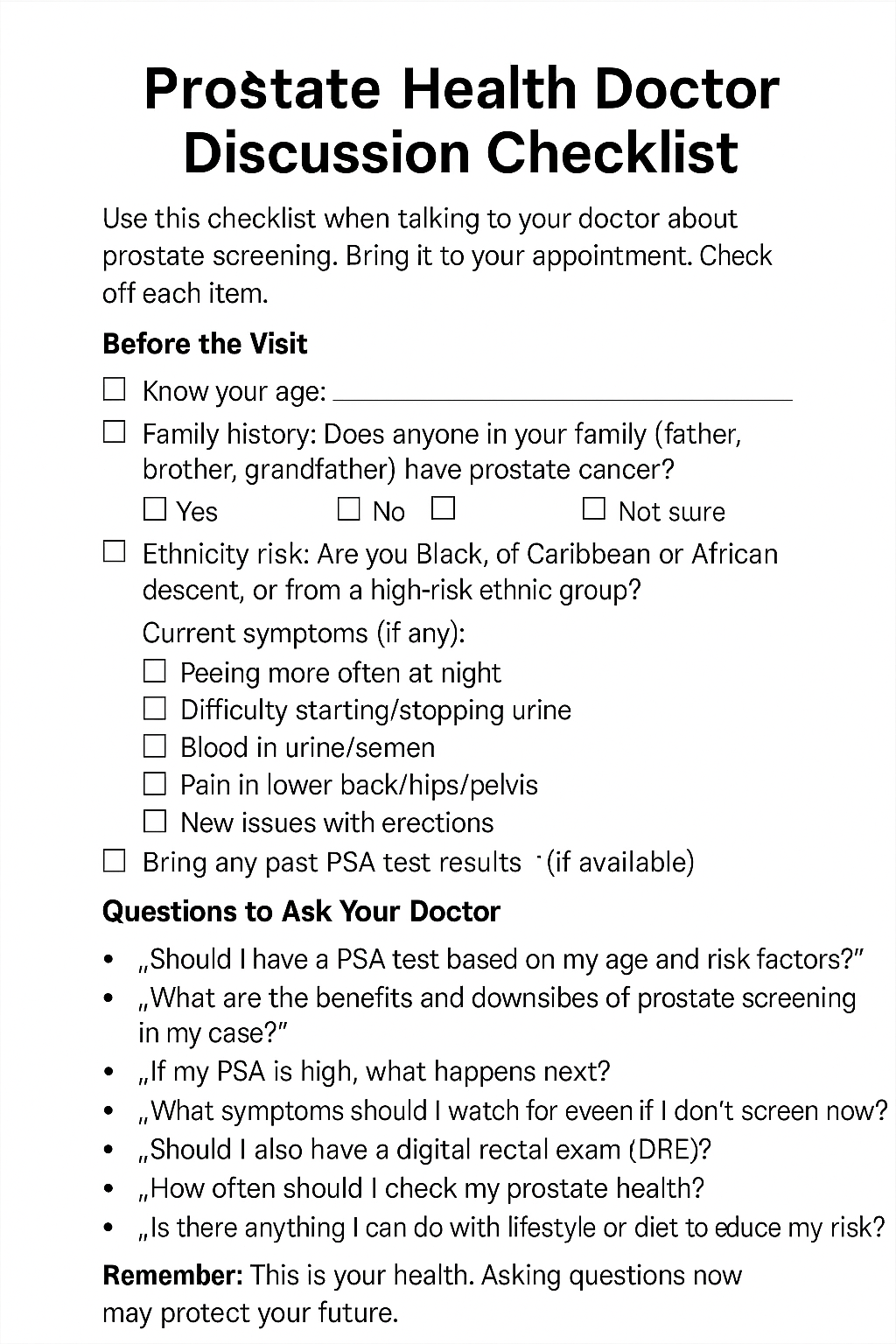
- Before the appointment, write down your risk factors: your age, family history (anyone with prostate cancer?), ethnicity, symptoms (if any), and any urinary/sexual worries.
- Ask your doctor these questions:
- “Given my age and history, should I have a PSA test?”
- “If my PSA is elevated, what do we do next?”
- “What are the pros and cons of screening in my case?”
- “What symptoms should I watch for in the future?”
- “If I choose to wait or not screen now, what signs would trigger screening?”
- Based on your discussion, agree on a monitoring plan (e.g., PSA every year or every two years; what threshold triggers referral; when to do a DRE).
- Keep the appointment and follow through — don’t postpone or avoid the topic.
You don’t need to wait for symptoms. You don’t need to be perfect. You need to start the conversation. That step alone can change your outcome.
- Prostate cancer is prevalent among men.
- Early detection gives you more and better options.
- Screening has trade‑offs, but talking with your doctor calibrates what’s right for you.
- Take action: book the appointment, ask the right questions, follow through.
Remember: your prostate health is part of your body’s story. You write some of the chapters based on how you act today. By bringing this up with your doctor, you take a proactive step. Don’t wait for a sign. Make the call.
If you have issues talking to your doctor about it for any reason, we have compiled a checklist. Click here to download it (no email required).

- Nighttime Urination & the Body’s Internal Clock
- 💧 Natural Ways to Stop Frequent Urination at Night (Nocturia Relief for Men Over 40)
- The Importance of Prostate Screening — and Talking to Your Doctor About It
- The Complete Guide to Nocturia: Why Men Wake Up at Night to Urinate (and How to Stop It)
- Modern Treatments for Nocturia: What Every Man Should Know