
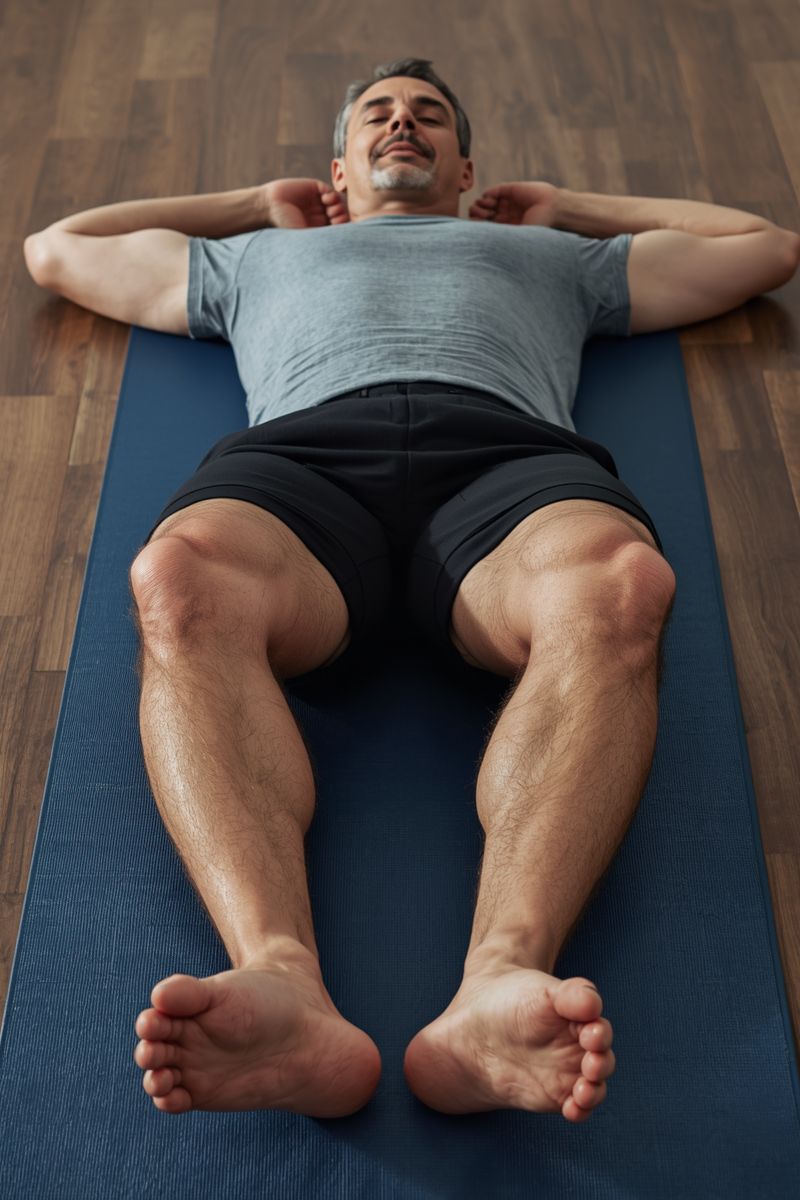
Pelvic floor exercises for men probably aren’t the first thing that comes to mind when you think about getting stronger.
You might train your chest, arms, legs, or core.
But underneath all of those muscles is another group you probably never think about—until something stops working quite as well as it used to.
Maybe you leak a few drops after urinating.
Maybe you’re constantly rushing to the bathroom.
Maybe your bladder doesn’t feel as easy to control anymore.
Or perhaps you’ve heard that strengthening your pelvic floor could help with erections, ejaculation, or sexual performance, and you’re wondering whether that’s actually true.
Men have pelvic floor muscles too.
And learning how to use them correctly can be surprisingly useful.
But there’s an important catch:
More squeezing isn’t always better.
Here’s how pelvic floor exercises for men work, how to find the correct muscles, and how to know whether strengthening them actually makes sense for you.
What Is the Male Pelvic Floor?
Think of your pelvic floor as a supportive layer of muscles at the bottom of your pelvis.
These muscles extend between the pubic bone and tailbone and help support structures including your bladder and bowel.
They also surround openings involved in urination and bowel movements and play a role in sexual function.
That means the same relatively unnoticed group of muscles is involved in several things men care quite a lot about:
- bladder control
- bowel control
- urinary function
- erections and sexual function
- ejaculation
You probably don’t notice your pelvic floor when everything is working normally.
Like many things in life, you tend to notice it when something changes.
What Do Pelvic Floor Exercises Do for Men?
Pelvic floor exercises—often called Kegel exercises—involve deliberately contracting and relaxing the pelvic floor muscles.
The goal isn’t simply to squeeze them as hard as possible.
You’re teaching yourself to identify, control, strengthen, and fully relax the muscles.
For some men, pelvic floor training may be useful for problems such as urinary leakage or post-urination dribbling. Pelvic floor training is also commonly used around prostate surgery and may have benefits for aspects of male sexual function.
But whether strengthening is appropriate depends on what is happening with your pelvic floor in the first place.
We’ll come back to that distinction shortly.
How Do You Find Your Pelvic Floor Muscles?
This is where many men get confused.
Fortunately, there are a couple of simple ways to identify the muscles.
Imagine you’re trying to:
stop yourself from passing gas
and at the same time:
stop the flow of urine.
You should feel a tightening and lifting sensation around the pelvic floor.
Some men may notice the base of the penis move slightly inward, or the testicles lift a little when the correct muscles contract.
Another way people commonly identify the pelvic floor is by briefly stopping the flow of urine midstream.
But there’s an important distinction:
That’s a test—not the exercise.
Don’t repeatedly perform Kegels while you’re urinating. Regularly interrupting urine flow can interfere with normal bladder emptying.
Once you know which muscles you’re looking for, exercise them away from the bathroom.
A Simple Pelvic Floor Exercise Routine for Men
You don’t need weights, machines, supplements, or a gym membership.
Start somewhere comfortable.
You may find it easiest to learn the movement while lying down or sitting.
Step 1: Relax
Let your stomach, thighs, and buttocks relax.
Breathe normally.
Step 2: Contract Your Pelvic Floor
Gently squeeze and lift the muscles you identified earlier.
Think about stopping the flow of urine and gas rather than clenching your entire lower body.
Step 3: Hold
Try holding the contraction for about 3 to 5 seconds.
Don’t hold your breath.
Step 4: Completely Relax
Release the muscles for roughly the same duration.
The relaxation matters too.
Step 5: Repeat
Start with a manageable number of controlled repetitions.
As the muscles become easier to identify and control, you can gradually work toward longer contractions and more repetitions.
Quality matters more than forcing yourself through a huge number of Kegels.

The Mistake That Can Make Kegels Useless
There’s an easy way to do pelvic floor exercises without really training your pelvic floor.
Squeeze everything.
Your abs tighten.
Your butt clenches.
Your thighs contract.
You hold your breath.
It certainly feels like you’re exercising something.
But the pelvic floor should be doing the work.
Try placing a hand on your stomach or thigh while practicing. If those muscles are strongly contracting every time you perform a Kegel, slow down and concentrate on isolating the pelvic floor.
This is one exercise where “harder” doesn’t automatically mean “better,” as I explain in that article.
How Many Kegels Should a Man Do?
There isn’t one magic number that’s ideal for every man.
A commonly recommended progression is to work toward approximately 10 controlled contractions per session, repeating the exercise several times during the day.
For example, Mayo Clinic recommends working toward 10 to 15 repetitions per set, with three sets per day.
But don’t turn that number into another internet challenge.
If you’re struggling to identify the muscles, experiencing discomfort, or becoming fatigued quickly, doing more repetitions isn’t necessarily the answer.
Technique comes first.
How Long Before Pelvic Floor Exercises Work?
Not four minutes.
That’s worth emphasizing because pelvic floor exercises sometimes get wrapped into the same quick-fix promises as supplements and home remedies.
The exercise itself may only take a few minutes.
Building stronger, better-controlled muscles takes longer.
Depending on the problem and the individual, improvements may take several weeks or months of consistent training.
Think about training any other muscle.
You wouldn’t do one set of bicep curls and check five minutes later to see whether your arms had grown.
Your pelvic floor deserves the same realistic expectations.
Can Pelvic Floor Exercises Help Frequent Urination?
Sometimes—but frequent urination has many possible causes.
Pelvic floor training can help improve bladder control in certain situations, particularly when poor pelvic-floor control or weakness contributes to urinary symptoms.
But frequent urination can also be associated with factors that strengthening these muscles won’t necessarily solve.
That’s why “I pee too often” isn’t enough information to determine the right solution.
If frequent bathroom trips are your main concern, read our guide to stopping frequent urination naturally and learn why identifying your particular symptom pattern matters.
Can Pelvic Floor Exercises Help With Nighttime Urination?
Possibly, depending on why you’re waking up.
Nighttime urination—also called nocturia—can have many potential contributors, including fluid habits, medications, sleep problems, bladder issues, and prostate-related urinary changes.
A stronger pelvic floor doesn’t automatically address all of those.
If your main problem is repeatedly getting out of bed to urinate, investigate why you’re waking up to pee at night rather than assuming Kegels alone will solve it.
Can Kegels Help a Weak Urine Stream?
A weak or stop-start urinary stream is another symptom where the underlying cause matters.
Pelvic-floor coordination plays a role in urination, but a weak stream can have other explanations, particularly as men get older.
If your stream has noticeably changed, read more about weak urinary flow in men rather than simply increasing the number of Kegels you perform.
Persistent or worsening changes should be discussed with a healthcare professional.
Can Pelvic Floor Exercises Improve Erections?
This is where the pelvic floor becomes especially interesting for men.
Pelvic-floor muscles participate in male sexual function, including mechanisms involved in erections and ejaculation. Medical sources, including Mayo Clinic and Cleveland Clinic, note potential sexual-function benefits from pelvic-floor training.
That doesn’t make Kegels a universal treatment for erectile dysfunction.
Erection problems can have cardiovascular, neurological, hormonal, medication-related, psychological, and other causes.
But if you’re interested in the relationship between pelvic-floor function and sexual performance, it’s a legitimate area to explore rather than simply dismissing Kegels as a “women’s exercise.”
Can Kegels Help With Ejaculation Control?
Pelvic-floor muscles are also involved in ejaculation.
Learning greater awareness and control of these muscles may therefore be useful for some aspects of sexual function.
But again, this isn’t a case where performing hundreds of Kegels automatically creates better control.
Being able to relax the pelvic floor can matter just as much as being able to contract it.
And that brings us to something many Kegel guides overlook.
When More Kegels May Be the Wrong Answer
Not every pelvic-floor problem is caused by weak muscles.
Sometimes the muscles can be overly tense or difficult to relax.
If that’s the case, repeatedly contracting them may not address the problem and could worsen symptoms.
Signs that deserve professional assessment can include pelvic pain, pain during or after sexual activity, difficulty relaxing the pelvic floor, or symptoms that become worse when you perform Kegels.
This is why the goal shouldn’t be:
“Make my pelvic floor as tight as possible.“
The better goal is:
Strength, control, coordination, and the ability to relax.
A pelvic-floor physical therapist can help determine what your muscles actually need and teach you how to use them correctly.
Common Pelvic Floor Exercise Mistakes
Before turning Kegels into a daily habit, watch for these common mistakes:
- holding your breath
- tightening your stomach
- clenching your buttocks
- squeezing your thighs together
- performing Kegels repeatedly while urinating
- doing excessive repetitions
- never fully relaxing between contractions
- continuing despite pain
- expecting immediate results
A small number of correctly performed contractions is more useful than dozens performed poorly.
How to Make Pelvic Floor Training a Habit
The biggest challenge may not be performing the exercises.
It’s remembering to do them.
Try attaching your pelvic-floor routine to something you already do every day.
For example:
After brushing your teeth.
While waiting for your morning coffee.
During a television commercial.
Before getting into bed.
Because nobody can see you doing a Kegel, you can practice almost anywhere once you’ve learned the correct technique.
Consistency matters more than finding the perfect moment.
What If You Don’t Know Which Urinary Problem You Have?
This is where Maleva Health’s approach becomes important.
A man waking four times every night isn’t necessarily dealing with the same problem as a man who leaks when he coughs.
And neither necessarily has the same problem as someone whose urinary stream has gradually weakened.
Before jumping from exercise to exercise—or supplement to supplement—identify the symptom that’s actually getting in your way.
If you’re unsure where to start, our short male urinary-health quiz can help you identify which area may be most useful to explore next.
Take the Male Urinary Health Quiz →
The quiz isn’t a medical diagnosis. It’s simply a way to organize what you’re experiencing and point you toward information that may be more relevant to your particular concern.
When Should You Get Professional Help?
Pelvic-floor exercises aren’t a substitute for medical evaluation.
Talk with a healthcare professional if you have new, persistent, or worsening urinary or sexual symptoms.
Seek prompt medical attention for concerning symptoms such as blood in your urine, fever, significant pain, or difficulty urinating.
And if Kegels themselves cause pain or seem to worsen your symptoms, stop assuming you need to exercise harder.
A pelvic-floor physical therapist or other qualified healthcare professional can assess whether weakness, excessive tension, poor coordination, or something else may be contributing.
The Bottom Line
Pelvic floor exercises for men aren’t complicated.
But doing them correctly matters.
Learn to identify the right muscles.
Contract them without squeezing your entire body.
Relax completely between repetitions.
Practice consistently.
And give the muscles time to adapt.
Most importantly, don’t assume that every bladder or sexual problem means your pelvic floor needs to become stronger.
Sometimes strengthening helps.
Sometimes the underlying problem is somewhere else.
And sometimes learning to relax the muscles is just as important as learning to squeeze them.
The goal isn’t to become the man who can do the most Kegels.
It’s to understand what your body actually needs.
Frequently Asked Questions About Pelvic Exercises for Men
How Do I Know If I’m Doing Male Pelvic Floor Exercises Correctly?
When you contract the correct muscles, you should feel a gentle tightening and lifting around the pelvic floor, similar to the muscles you would use to stop passing gas or briefly stop urine flow.
Your stomach, thighs, and buttocks should remain relatively relaxed, and you should be able to breathe normally throughout the exercise.
If you’re unsure whether you’re using the correct muscles, a pelvic floor physical therapist can assess your technique and help you learn the movement properly.
Can Men Do Too Many Kegels?
Yes. More Kegels aren’t necessarily better.
Your pelvic floor muscles need both contraction and relaxation. Excessive training—particularly if the muscles are already tight—can contribute to discomfort or symptom worsening.
Focus on controlled repetitions, complete relaxation between contractions, and good technique rather than trying to perform as many Kegels as possible.
Can Kegels Make Pelvic Floor Problems Worse?
They can in some situations.
Not every pelvic floor problem is caused by weak muscles. Some men have an overly tight or hypertonic pelvic floor, in which the muscles have difficulty relaxing properly.
Adding more strengthening exercises to an already tight pelvic floor may worsen symptoms for some men. If Kegels cause pain, increased tension, or worsening urinary or sexual symptoms, stop and consider seeking assessment from a pelvic floor physical therapist rather than simply exercising harder.
Can Pelvic Floor Exercises Help Men Get Stronger Erections?
Pelvic floor muscles contribute to the mechanisms underlying erections, and research suggests that pelvic floor training may help some men with erectile function.
However, erection problems can have many causes, including cardiovascular, neurological, hormonal, medication-related, and psychological factors. Kegels shouldn’t be viewed as a universal treatment for erectile dysfunction.
If erection problems are persistent or new, identifying the underlying cause is more important than assuming the pelvic floor is weak.
Do Kegels Help Men Last Longer During Sex?
The pelvic floor plays a role in ejaculation, so learning better awareness and control of these muscles may be useful for some men.
However, simply performing more Kegels doesn’t guarantee better ejaculation control. An overly tight pelvic floor may actually be part of the problem for some men, which is why the ability to relax these muscles can be just as important as the ability to contract them.
If you’re using pelvic floor exercises specifically for ejaculation control, think in terms of control and coordination rather than maximum strength.
Rickard